Why Community Investment Matters to Coffey Bros Moving
Businesses often talk about being part of a community, but for many companies, that connection rarely extends beyond providing services to local customers. For Coffey Bros Moving, community involvement has become something much deeper. The Chicago-based moving company views community investment not as a charitable obligation but as a responsibility that comes with operating and growing within the city it serves.
The company’s commitment to local organizations, youth programs, and community initiatives reflects a belief that successful businesses should contribute to the long-term well-being of the neighborhoods that support them. It is a philosophy that has shaped Coffey Bros Moving’s culture and helped define its mission beyond the logistics of moving families and businesses from one location to another.
“Everything we’ve accomplished as a company has happened because of the people and communities around us,” says Ken Coffey, owner of Coffey Bros Moving. “When a city supports your business for years, you develop a responsibility to support that city in return. Community investment is our way of honoring that relationship.”
That perspective aligns with a growing body of research suggesting that strong communities and strong businesses are closely connected. According to the U.S. Chamber of Commerce Foundation, communities with active civic engagement and local investment often experience greater economic resilience and stronger long-term growth. Businesses benefit when neighborhoods are stable, residents are engaged, and local organizations have the resources they need to address challenges effectively.
For Coffey Bros Moving, community investment begins with recognizing that a moving company occupies a unique position within the local economy. Every day, employees work directly with families, business owners, property managers, and community members experiencing significant life transitions. Those interactions provide a firsthand view of the opportunities and challenges that exist throughout Chicago’s neighborhoods.
“We spend our days inside communities,” Coffey explains. “We see people starting new jobs, growing businesses, buying homes, and building futures. That gives us a unique appreciation for the organizations working behind the scenes to help those communities thrive.”
One area where the company has focused its support is youth development. Programs that provide mentoring, leadership training, and educational opportunities can have effects that extend far beyond individual participants. Research conducted by the Search Institute has shown that young people who have access to strong developmental relationships are more likely to succeed academically and become engaged members of their communities later in life.
Investing in those programs reflects a long-term perspective. While the results may not be immediately visible, helping young people develop skills and confidence today contributes to stronger neighborhoods in the future. For companies that genuinely care about the communities they serve, that type of investment can be among the most meaningful.
Community investment also plays an important role inside the company itself. Employees increasingly want to work for organizations whose values extend beyond profitability. A workplace that actively supports charitable causes and community organizations often creates a stronger sense of purpose among team members.
A study by Deloitte found that employees who believe their employer positively impacts society report higher levels of loyalty and engagement. Those findings suggest that community involvement can strengthen organizational culture while reinforcing the values that employees want to see reflected in their workplace.
According to Coffey, that connection is evident throughout the company.
“Our team wants to know they’re making a difference,” he says. “Of course we’re helping customers with their moves, but when employees see the company supporting local causes, it reinforces the idea that we’re contributing to something bigger than ourselves.”
Community investment also helps strengthen trust between businesses and the people they serve. In an era when consumers increasingly evaluate companies based on their values and actions, meaningful local involvement demonstrates a commitment that extends beyond commercial transactions. People often prefer to support organizations that have demonstrated a genuine interest in improving the places where they operate.
That trust becomes especially important in a city like Chicago, where neighborhoods have strong identities and deep community roots. Businesses that actively engage with local organizations often become viewed as stakeholders in the community rather than simply service providers.
For Coffey, however, the value of community investment cannot be measured solely through business outcomes.
“If you’re only looking at community support through a business lens, you’re missing the point,” he says. “The real value comes from knowing that you’re helping create opportunities for people, strengthening organizations, and contributing to a better future. That’s something every successful business should aspire to do.”
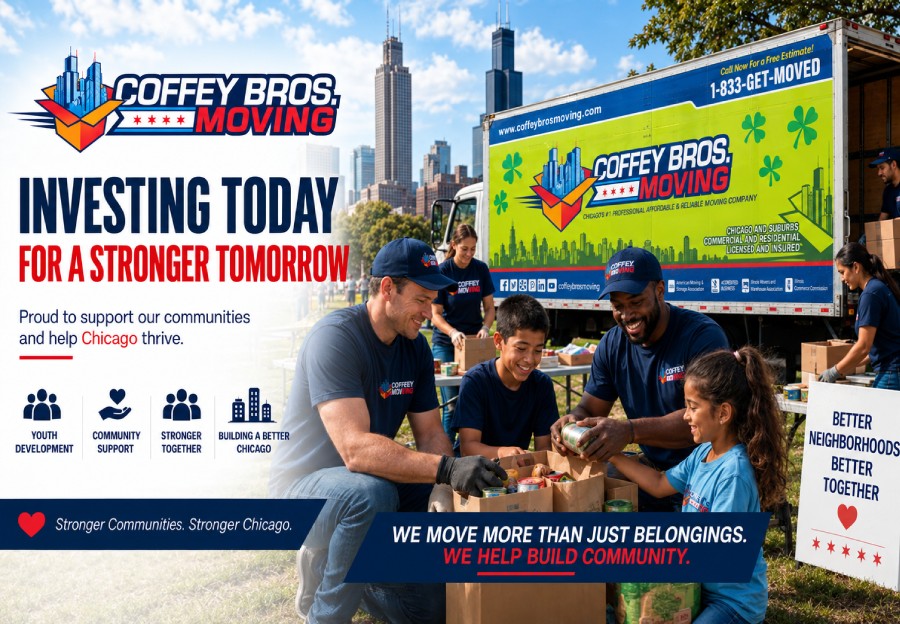
The philosophy behind Coffey Bros Moving’s community involvement is ultimately rooted in a simple idea: success creates opportunities to help others succeed. By investing in organizations that support education, leadership development, and community growth, the company contributes to the strength and vitality of the city that has supported it for decades.
For Coffey Bros Moving, community investment matters because communities matter. Strong neighborhoods create stronger cities, stronger families, and stronger businesses. Supporting that cycle is not simply a charitable effort. It is an investment in the future of Chicago itself.